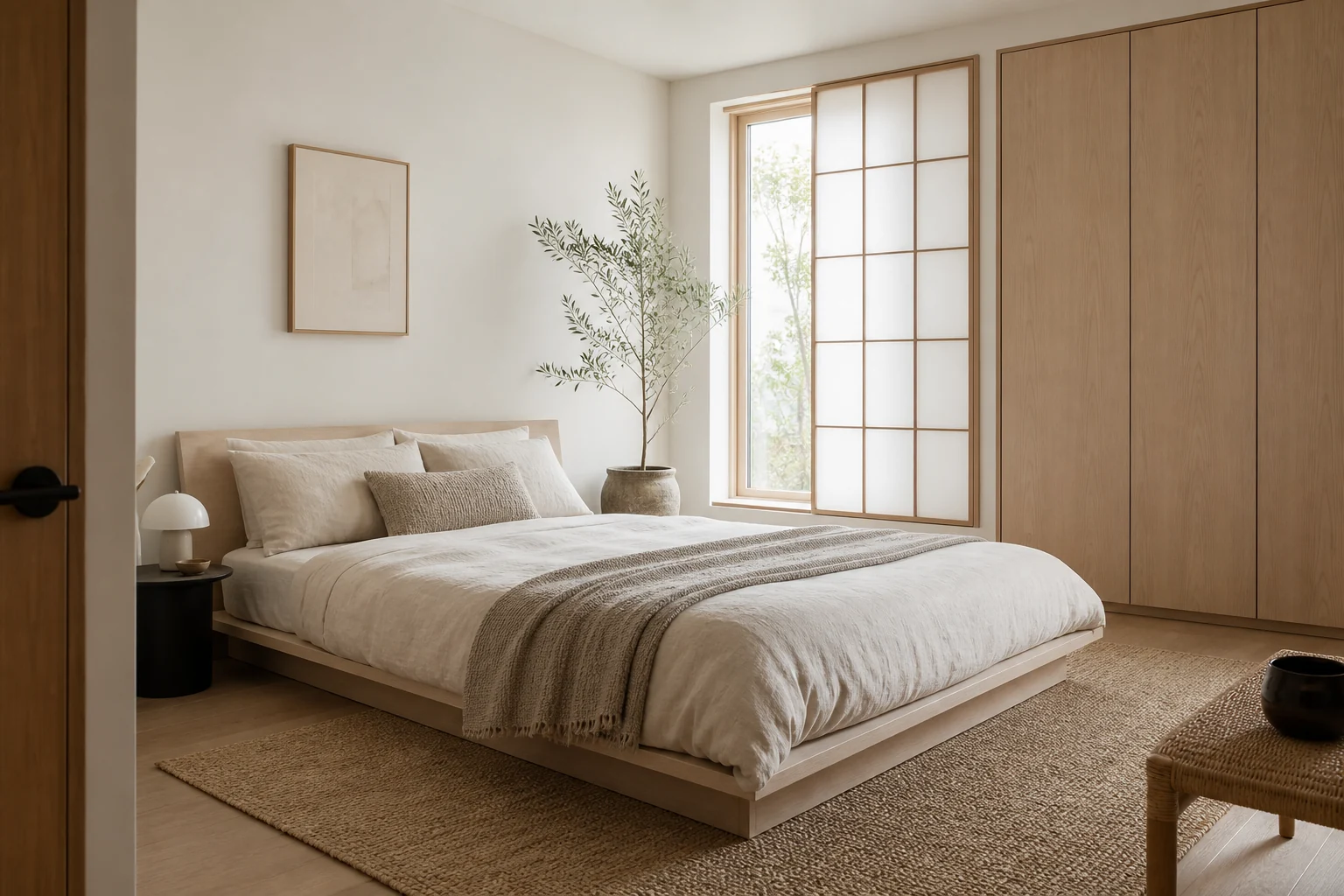
What defines a Japandi bedroom
Japandi bedroom design sits at the intersection of two traditions that already agreed on the essentials: Japanese wabi-sabi, which finds beauty in imperfection and restraint, and Scandinavian functionalism, which insists everything in the room earns its place. In a bedroom this translates into one dominant decision — a low platform bed, usually in white ash or oak, positioned so the room keeps as much open floor as possible. Around it, negative space is treated as a feature, not something to fill.
The color story stays narrow on purpose: off-white and oatmeal walls, pale wood tones, and one or two ink-black accents — a lamp, a frame, the spine of a chair. Texture does the work that color usually does. Linen bedding, a rattan bench, an unglazed ceramic vase: each surface is matte and natural, so light spreads softly instead of bouncing. Storage disappears into handle-less wardrobes, and where a divider is needed, shoji-style sliding panels filter light instead of blocking it.
Decoration is close to zero. A single statement plant — commonly a Japanese maple branch or a potted olive — replaces the usual gallery wall. If you keep art, keep one piece, unframed or thin-framed, hung lower than you would expect; Japandi rooms pull the eye downward, following the low bed line.
This is the style to try first if your bedroom is small or visually noisy. Because the AI keeps your walls, windows and layout while swapping furniture mass for floor space, Japandi makeovers tend to produce the most dramatic “same room, twice the air” effect of any style in this generator.